
Glass joint sizes explained: 10 mm, 14 mm and 18 mm
Glass care4 min readBy Utopia Smoke Shop
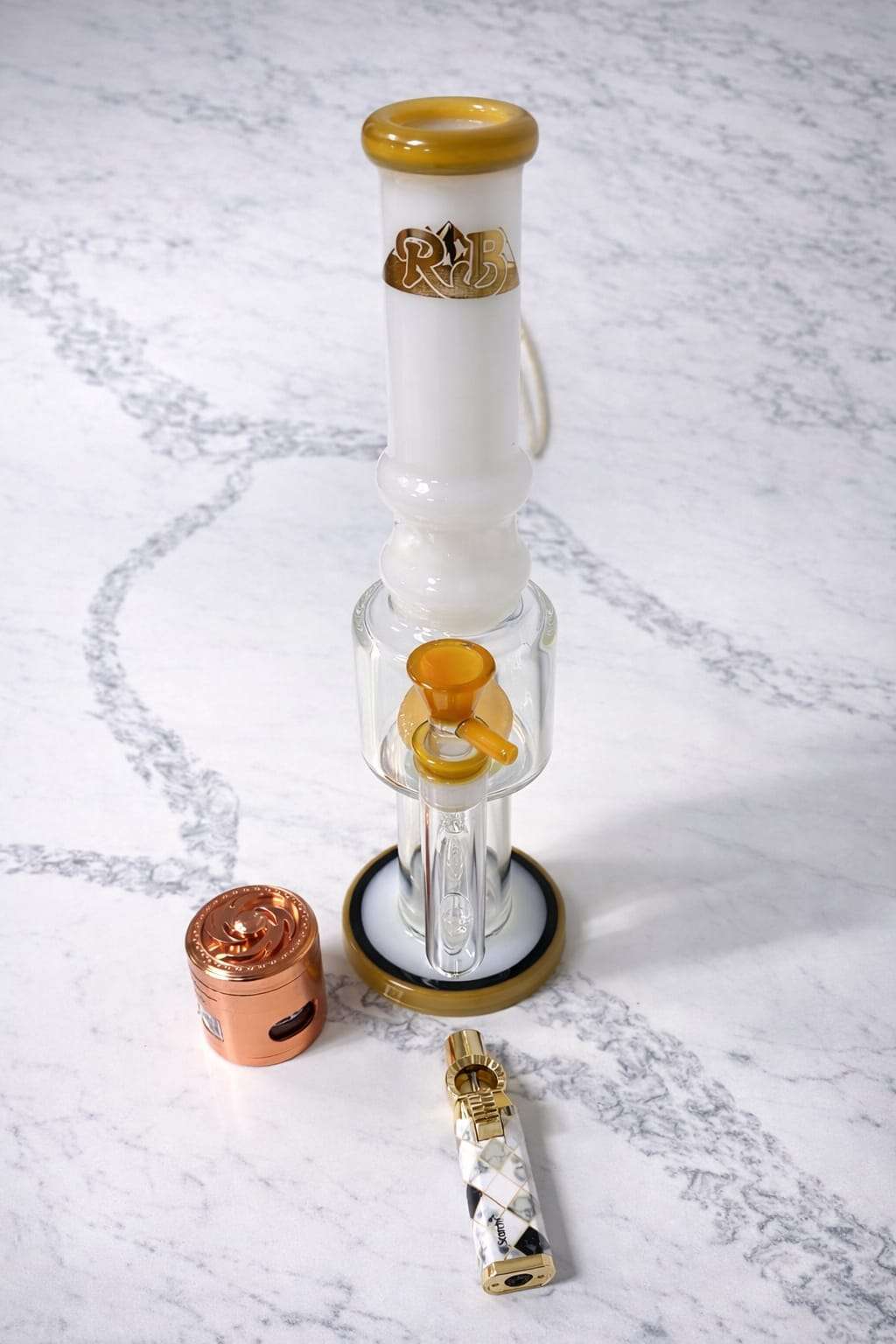
Learn the three common glass joint sizes, male vs female joints, how to measure a joint at home with a ruler or a dime, and when to use an adapter.
Glass water pipes use three common joint sizes: 10 mm, 14 mm and 18 mm. A part fits only when the size matches and the type is the opposite, so a 14 mm male bowl goes into a 14 mm female joint. You can work out what you have in a minute with a ruler, or roughly with a dime.
What a glass joint is
The joint is the frosted, tapered fitting where two pieces of glass connect and seal, such as a bowl and a downstem.
The size is the width of the wide end of the taper, and the numbers are rounded. A 14 mm joint is really about 14.5 mm. An 18 mm joint is about 18.8 mm, which some makers label 19 mm. They are the same fittings.
- 10 mm: the smallest, found on compact pieces and small rigs.
- 14 mm: the most common size, and the usual size for bowls.
- 18 mm: the largest, common on bigger beakers and straight tubes.
Male vs female joints
A male joint is a tapered plug, frosted on the outside. A female joint is a socket, frosted on the inside. Male goes into female. Two of the same type will not connect without an adapter.
Most water pipes have a female joint on the body, and many beakers add a removable downstem. A typical setup is an 18 mm female joint on the pipe, a downstem that is 18 mm male on the outside and 14 mm female at the top, and a 14 mm male bowl.
How to measure a joint at home
A ruler with millimeter marks is the most reliable tool.
- Female joint: measure straight across the inside of the opening.
- Male joint: measure across the widest part of the frosted section.
- Match the reading: it will land near 10 mm, 14.5 mm or 19 mm.
The dime check
A US dime is 17.9 mm across, just under the true width of an 18 mm joint.
- Lay the dime flat on a female joint. If it slips just inside the opening, the joint is 18 mm.
- If the dime rests on top and covers the hole, the joint is 14 mm.
- If the hole is barely over half the width of the dime, it is 10 mm.
- For a male joint, hold the dime beside the frosted end. About the same width means 18 mm, and clearly narrower means 14 mm.
Treat this as a rough check and confirm with a ruler.
45 degree vs 90 degree joints
A 45 degree joint slants up from the side of the piece, the usual layout on a beaker. A 90 degree joint points straight up, which is common on small rigs and on straight tubes with a fixed downstem.
A plain bowl works at either angle. Add-on parts that hold water, such as ash catchers, are made in 45 and 90 degree versions and have to match the joint to sit level.
When to use an adapter
Adapters change a joint's size, type or angle. Common ones step between 14 mm and 18 mm, or join male to male and female to female.
Use one when you already own a good part in the wrong size. Skip it if you would need to stack two. Every adapter adds height, leverage on the joint and one more part to clean. Buying the correct bowl or downstem is usually the tidier fix.
Common joint mismatches
- Measuring the wrong joint. The pipe is 18 mm, but the downstem takes a 14 mm bowl. Measure the part the bowl sits in.
- A rocking fit. A correct part seats with the frosted surfaces fully touching. A wobble means the size is off.
- Forcing it. Never push or twist hard. Joints are a weak point on any piece, as covered in borosilicate vs soft glass.
Does joint size change how a pipe pulls?
A little. A wider joint and downstem move more air with less resistance, so an 18 mm setup usually pulls more freely than a 10 mm one. The percolator and the shape of the piece matter more. See percolators explained and beaker vs straight tube for those.
Check the fit in person
The surest way to get a match is to bring the old bowl or downstem and compare it at the counter. Utopia Smoke Shop is at 7625 Firestone Blvd, Downey, CA 90241, open every day from 7 AM to 2 AM. Call (562) 390-0580 to ask which sizes are on the shelf, or browse the glass collection. Adults 21 and over only.
Keep reading.
Glass care4 min read
Percolators explained: types, drag and cleaning trade-offs
What a percolator does inside a water pipe, the seven common types, how each affects drag and cleaning, and how much water a percolator needs.
Glass care4 min read
Beaker vs straight tube: how to choose a water pipe shape
Beaker or straight tube? Compare base stability, water volume, how each shape clears, cleaning, storage, glass thickness and joint sizes.
Glass care4 min read