
Percolators explained: types, drag and cleaning trade-offs
Glass care4 min readBy Utopia Smoke Shop
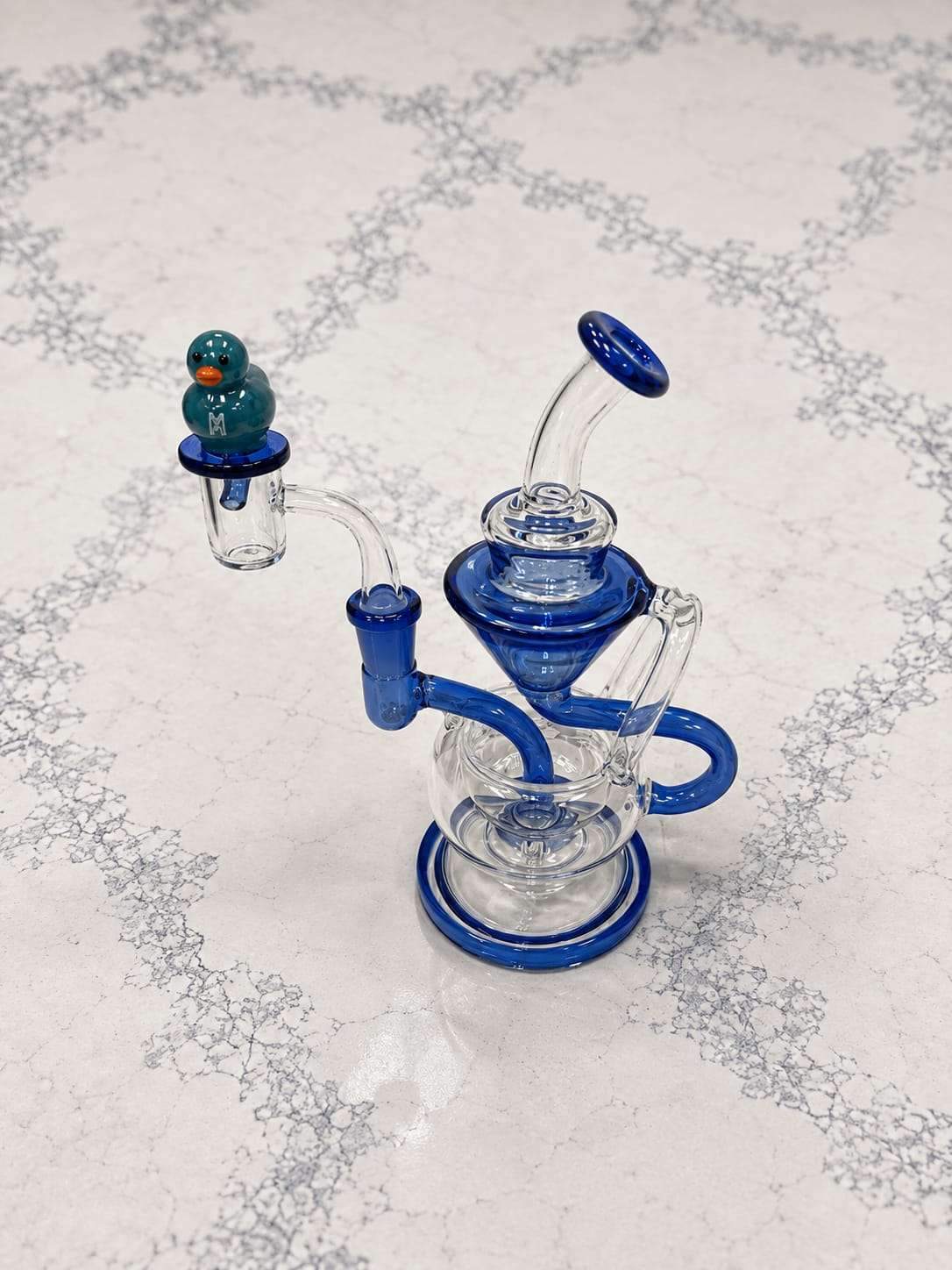
What a percolator does inside a water pipe, the seven common types, how each affects drag and cleaning, and how much water a percolator needs.
A percolator is a glass part inside a water pipe that breaks the airflow into many small bubbles. Small bubbles put more smoke in contact with the water, which cools the draw. The price is drag, meaning the resistance you feel when you pull, and a harder cleaning job.
What a percolator does
Without a percolator, air leaves the downstem as a few large bubbles. A large bubble has little surface for its volume, so most of what is inside never touches the water. A percolator forces the same air through slits or small holes. It comes out as a stream of fine bubbles with far more surface area, and they give up heat to the water as they rise.
So the draw feels cooler, and it takes more effort to pull. Every design balances those two.
Common percolator types
Diffused downstem
The simplest kind. The downstem ends in a ring of slits or holes instead of one open tip. Drag is low, and it lifts out for cleaning.
Tree
A dome with several thin arms hanging from it, each with slits near the tip. More arms mean more bubbles. The arms are the fragile part, and residue collects inside them.
Honeycomb
A flat disc across the tube, drilled with dozens of small holes. It gives strong diffusion with low drag in very little height, so makers often stack two or three. The small holes can clog.
Showerhead
A vertical tube that flares at the bottom, with slits or holes around the flared end. Drag is moderate, and the shape is open enough to rinse well.
Inline
A horizontal tube with a row of slits, set low in the base. It is common on straight tubes and rigs. It is fixed in place, so it gets cleaned by soaking and shaking.
Matrix
A cylinder cut with a grid of vertical and horizontal slits, sometimes called a birdcage. It makes very fine bubbles with noticeable drag, and the many small cuts take longer to clean.
Turbine
A disc with angled slits that spins the water into a whirlpool. Drag is low, and the spin helps keep water from climbing the neck. It breaks the air up less than a honeycomb does.
A recycler is a layout, not a percolator. It carries water up with the air into a second chamber, then drains it back to the base in a loop.
Drag and cleaning trade-offs
More percolation is not automatically better.
- Drag adds up. Each percolator adds resistance. Two or three stacked chambers can take a long, strong pull to clear.
- Small openings clog first. Once some slits are blocked, the draw gets tighter and uneven.
- Fixed parts cannot be scrubbed. They rely on alcohol, salt and soaking, as described in how to clean a glass water pipe.
- More glass means more to break. Extra chambers add weight, cost and fragile welds.
If low upkeep matters most, a simple beaker or straight tube with a diffused downstem is the easy choice. Beaker vs straight tube covers how the body shape changes the pull.
How much water a percolator needs
Water level changes how any percolator behaves.
- Just cover the openings. Fill until the slits or holes sit under the surface, by about a centimeter at most.
- Too little water and air slips past above the waterline. The percolator does nothing.
- Too much water adds drag and sends splash toward the mouthpiece.
- Several chambers? Pour water in through the mouthpiece so the upper percolator gets its share, then check each level.
Test before you use it. Draw gently with an empty bowl in place. Every slit should bubble, and no water should reach your lips.
Hard tap water leaves mineral scale that narrows small holes over time. The fix is in hard water stains on glass.
Which percolator is easiest to clean?
A removable diffused downstem. You can lift it out, soak it in a bag and run a pipe cleaner through it. Showerheads and honeycombs come next. Trees and matrix percolators take the most patience. Whatever the type, change the water every time and clean about once a week so residue never hardens in the slits.
Look before you buy
In person you can see how fine the slits are, how the chambers connect and how you would get the water out. Replacing a downstem? Check the fitting first with glass joint sizes explained.
Utopia Smoke Shop is at 7625 Firestone Blvd in Downey, open every day from 7 AM to 2 AM. Browse the glass collection, or call (562) 390-0580 to ask what is on the shelf. Utopia is for adults 21 and over.
Keep reading.
Glass care4 min read
Glass joint sizes explained: 10 mm, 14 mm and 18 mm
Learn the three common glass joint sizes, male vs female joints, how to measure a joint at home with a ruler or a dime, and when to use an adapter.
Glass care4 min read
How to clean a glass water pipe with alcohol and salt
Clean a glass water pipe at home with isopropyl alcohol and coarse salt. A step-by-step method, how often to do it and the mistakes to avoid.
Glass care4 min read